"....Henri Lemaitre asserted that "Alexander Cozens's experiments of the 1740s and 50s presaged the art that we would later call 'abstract,'" and also cited the influence of "the Far East" on his technique.(4) Louis Hawes in 1969 compared Cozens's depictions of cloudy skies to "a Clyfford Still canvas turned on its side."(5) E. H. Gombrich and Henri Zerner both linked the blots to the famous psychological test introduced by Hermann Rorschach in 1921, and Zerner complemented this anachronism by citing the roots of Cozens's method in the seventeenth-century practice of Baroque artists who would "throw the first thoughts of their compositions in masses of light and shade."(6) The problem underlying these anachronistic attempts to account for Cozens's work is the emphasis placed on the final formal appearance of the blots, to the exclusion of the theory of artistic process that produced their f..." Cramer, Charles A, Alexander Cozen's 'New Method': the blot and general nature, The Art Bulletin › Vol. 79 Nbr. 1, March 1997
It would have been easier if [...] had also written about colour gradations. But he didn't, so each of these works adds a little statement to colour as we know it.
"ABSTRACT iPAD DRAWINGS PUT ONTO PAPER", NRC Handelsblad, Cultural Supplement, February 7, 2013, review by Gijsbert Van Der Wal
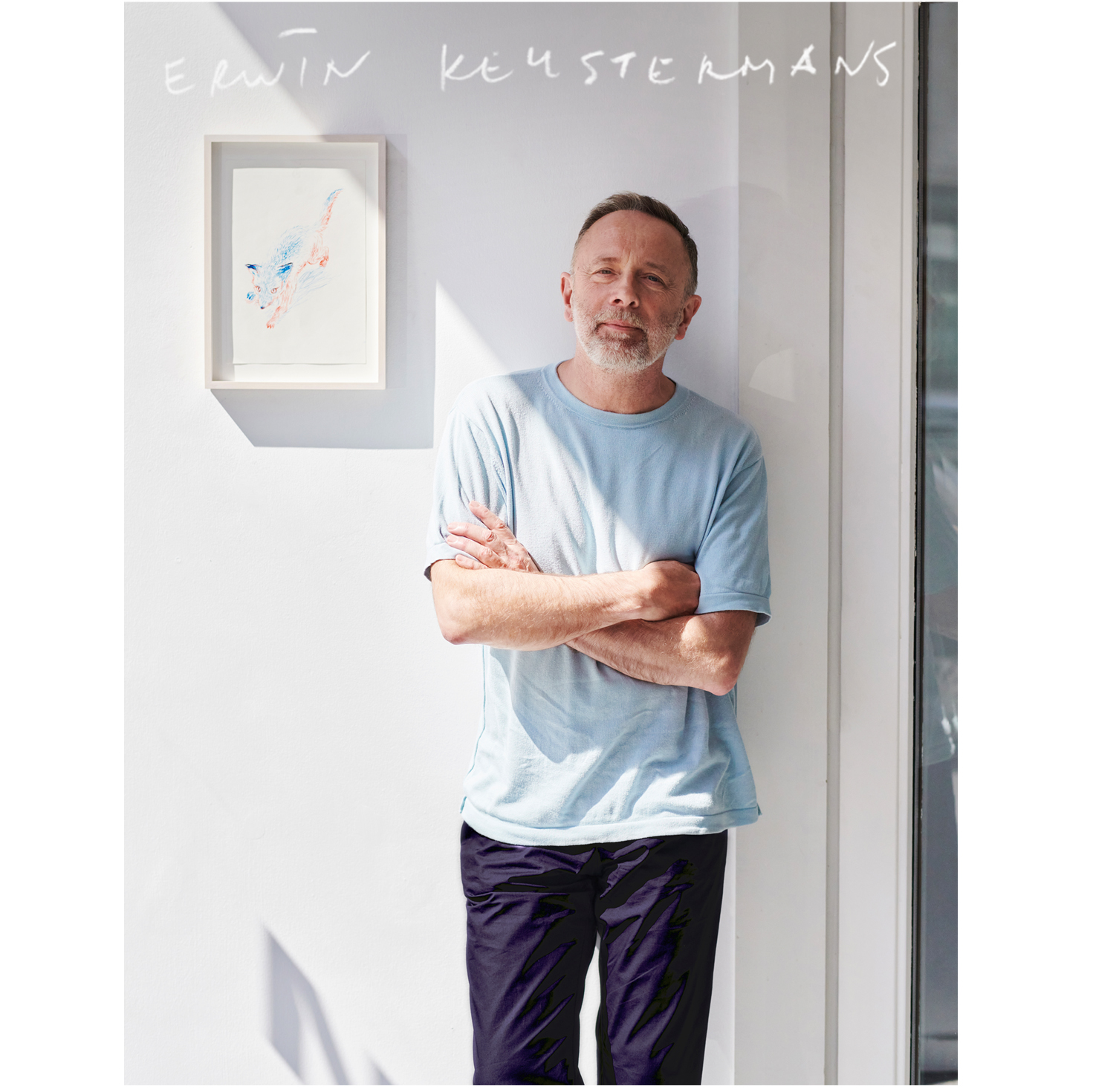
These days many painters and draughtsmen use every now and then an iPhone as a sketchbook, or a tablet as a canvas. The Belgian artist Erwin Keustermans (1960) went the other way around. Trained as a philosopher and having worked for many years in advertising and media, he started about five years ago to make art and showed it on line. Sensitive and thoughtful, the way philosophers do, he drew on the touch screen, using his index finger and the occasional thumb. His finger movements resulted in compositions with abstract patterns, flat and black and white, meant to be printed in limited editions. Contemporary graphics.
The next step was the suggestion of space. Mr. Keustermans attuned the drawing program on the iPad as to render the tablet soft. The touchscreen became a slab of wax or clay, in which he could poke and knead. The imprint of his thumbs grew virtual shadows. Initially he thought of printing the picture that emerged in large format, but he changed his mind and drew the large version by hand using pencil and chalk on tinted paper. The iPad became the lab, pretty much in the way a computer demo of a music piece may precede a performance with real instruments.
From touch screen to paper, from computer to crafts. Many hours went into the large drawings, because the light and shadows in the large thumb imprints had now to be rendered with pencil strokes. And so, in its turn the resulting hatches remind us of the patterns in Keustermans' previous iPad drawings. The strokes move and spread in different directions. The lines are sprayed on as rain in the wind, or fan out in a star, as hairs on a head.
So in the end mr. Keustermans returns his pencilled finger imprints the echo of ridges they lack on the iPad."
An obnoxious race with two-sided symmetrical features. As opposed to the radially symmetrically that exude balance and eternal repetition the bilaterals stagger forward towards their extinction.
This is me. I plug my ears and close my eyes. There is nothing between the tool and the thought. Nothing that is not me.
I reach towards the nearest surface and wa-a-a-a-ver in the space that is left to me by dynamics and kinematics.
So what if the hand thinks, and the scribbles it makes are expressive of nothing but … itself.
No formalism, no reference, here it goes, WATCH THE THING GO.
PAINTING is a subspecies - next to DRAWING - of MARK MAKING.
It is the production of a mark in which the mark itself is more prominent than the space it divides, than the areas surrounding it. This opposed to DRAWING where the mark appears as a separating line.
In fact, PAINTING represents a SURFACE rather than a LINE, geometrically speaking.TRIVIAL maybe, obvious NOT.